1937 Painting Smartphone Mystery: Mirror or Time Travel?
A 1937 painting smartphone mystery has sparked time-travel theories, but the mysterious object is more likely a hand mirror from the colonial era in America.
By zyrastic zx · September 17, 2026 · 3 min read
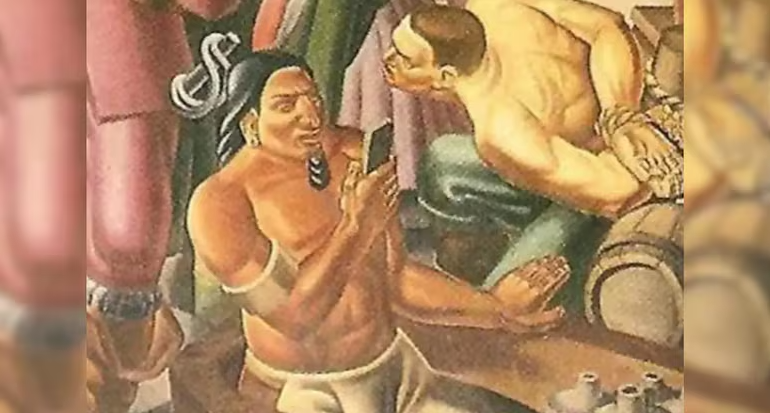
A nearly 90-year-old mural has drawn fresh attention after viewers spotted an Indigenous man holding an object that looks remarkably like a modern smartphone.
Historical context offers a far less mysterious explanation.
A small rectangular object in a 1937 mural has become the unlikely focus of a modern internet mystery. In Umberto Romano’s Mr. Pynchon and the Settling of Springfield, an Indigenous man appears to be examining something that, at first glance, resembles a smartphone.
The painting depicts the establishment of Springfield, Massachusetts, in the 17th century, centuries before mobile phones existed. That apparent mismatch has prompted social media users to joke that the artwork could contain evidence of time travel.
But there is no evidence that Romano intended to paint a futuristic device. A historical explanation is considerably more plausible.
Why the object looks like a smartphone
The figure is holding a dark, rectangular object close to his body, while his gaze is directed toward it. Its shape and the way it is positioned create an unmistakable resemblance to the way people today hold and look at their phones.
That visual similarity has been enough to fuel speculation online. Posts circulating on social media have described the object as an iPhone or suggested that the mural somehow depicts technology from the future.
The mural itself, though, was created in 1937 by Italian-American artist Umberto Romano. It is part of a six-panel series about Springfield's history and was produced with the help of several students under the Federal Arts Project. The murals remain in the building that originally housed Springfield's main post office and is now the Commonwealth of Massachusetts State Office Building.
The mirror explanation makes more historical sense
The strongest explanation for the mysterious object is that it is a hand mirror.
Mirrors were known trade goods during the colonial period, making one a reasonable object to appear in a scene depicting interactions between European settlers and Indigenous communities. The figure's pose can also be interpreted as someone looking at his reflection rather than using an electronic device.
Other interpretations have circulated, including the possibility that the object could represent a small book or another period object. None provides evidence of modern technology appearing in the 17th-century scene.
The apparent resemblance is therefore more likely a case of modern eyes finding a familiar shape in an old artwork.
What the mural actually depicts
The painting centres on William Pynchon, an English settler associated with the founding of present-day Springfield. According to the Smithsonian National Postal Museum, Pynchon led an expedition to the Connecticut River Valley in the 1630s and later established a settlement after purchasing land from local tribal leaders.
Romano's mural is not intended as a single frozen historical scene. The Smithsonian describes it as a broad representation of different aspects of Springfield's establishment, with multiple figures and events brought together in one composition.
Romano also consulted local historian Harry Andrews Wright and historical author Esther Forbes while developing the murals. The six-panel series covers the region's history from 1636 to 1936.
That context makes the supposed smartphone less mysterious. The artist was attempting to portray historical themes through a highly stylised composition, rather than secretly inserting a piece of technology from nearly 70 years in the future.
Why the time-travel theory keeps returning
The image is not new. The same smartphone-like detail has attracted internet attention before, with the resemblance repeatedly becoming the basis for jokes and speculation about time travel. A historical resource documenting the Springfield murals notes that the figure looking into what appears to be a mirror has long been compared online with someone checking an iPhone.
What has changed is the way the image is interpreted. To a modern viewer accustomed to seeing people constantly looking at rectangular screens, the pose immediately suggests a smartphone.
There is still no evidence, however, that the object is one. The Smithsonian's documentation identifies the artwork, its historical setting and Romano's artistic approach, while the mirror interpretation fits the period far better than a futuristic-device theory.
So while the 1937 mural may look uncannily modern in one small detail, the explanation appears to be much more ordinary: an old painting, a period-appropriate object and a very modern way of looking at it.
Advertisement




Comments (0)
No comments yet. Be the first to comment.